
![]() |
![]() |
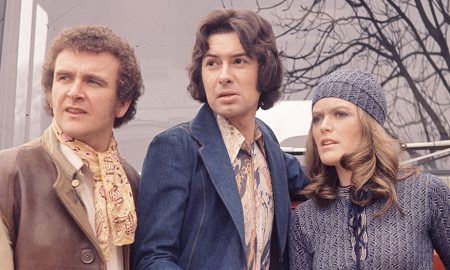
A SUPERLATIVE anthology of hour-long suspenseful playlets about well-tailored middle class types methodically doing each other in, THRILLER was a textbook example of straightforward, unpretentious telly drama doing its job to perfection. Mastermind BRIAN CLEMENS conceived and wrote most of the six series: forty three stories of suspense and horror, sometimes with supernatural overtones, often with an American guest star on the books for export purposes, always with plenty of plot twists.
The pre-title sequences were reassuringly formulaic, setting the tone for each week’s dose of macabre happenings in, more often than not, a superficially cosy remote provincial setting.. A charming cottage was seen being cased by a sinister type in a Gabardine coat, or maybe a flashy TR7 would pull into the driveway of a well-appointed country house, arousing the suspicions of the gardener. Something was clearly afoot. Then came the credits, a blood-tinged fish-eye lens title sequence with jarring musical chords, signalling ‘suspense’ in no uncertain terms. Corny episode titles belied the finely-tooled drama they would herald. ‘The Eyes Have It’ was a case in point: a daft pun introducing a largely silent, almost unbearably suspenseful tale of blind medical students (including DENNIS WATERMAN and SINEAD CUSACK) thwarting PETER VAUGHAN’s gang of taciturn terrorists. Elsewhere, the likes of ‘Murder in Mind’ and ‘K is for Killing’ served up exactly what they promised, and needless to say, if Clemens could bodge up a title by working the word ‘scream’ into a well-known expression, he did.
![]() |
![]() |
Primark Hitchcock it might have been, but the suspense was well-made for all that. Essentially, the series toyed with clichés. Young married couple freshly moved into mysterious rural location, stranger turning up who may not be all he seems, unidentified killer on the loose etc. It was the masterly variations and wrong-footings wrought from these familiar scenarios that made the programmes riveting, even when acting and production values started to exhibit the tell-tale signs of mid-series sag. Quite often, however, there were great performances, both from name actors (witness DIANA DORS’s sinister country nurse, ‘taking care’ of a bed-ridden American diplomat’s daughter in ‘Nurse Will Make It Better’) and those yet to find fame, particularly one that stops everyone in their tracks, HELEN MIRREN as the potential victim (or – ahem – is she?) of serial wife-knobbler MICHAEL JAYSTON in ‘A Coffin for the Bride’. DINSDALE LANDEN’s turn as suave private eye Matthew Earp was so popular he became the series’ only recurring character, when he was brought back for a second episode. When everything came together, as with the endless double-crosses and revelations and a brilliant cast led by PETER BOWLES in ‘The Double Kill’, you couldn’t ask for a better way to pass an hour of prime time.
This was, as you might expect, a very early ’70s kind of intrigue. Try and play a postmodern drinking game, quaffing along with the hero, or taking a sip every time a detective is seen entering a living room refracted in a crystal decanter, or a white shag-pile carpet is stained crimson with blood, or an anonymous black-gloved hand picks up a telephone receiver and slowly dials a very long number, or a blonde American in a trouser suit merrily announces that she’s ‘new in town’ and you’ll be under the glass coffee table before the first victim. And, quite frankly, serves you right. The show signalled its era in other ways: ‘If It’s a Man, Hang Up’ had Clemens’ stock glamorous soubrette-in-peril (more often than not called ‘Suzy’, the significance of which remains a mystery) menaced by an unknown stalker leaving threatening messages on a big, clunky old telephone answering machine. One of the main things mitigating against any modern revival of the programme is the number of plots that revolve around young women not being able to get to a phone box in time, or killers cutting the phone lines to a remote country cottage. In that sense, as well as that of the many swish glass-’n'-chrome bachelor pads dreamt up by the set designers, this is period drama.
![]() |
![]() |
They weren’t wall-to-wall classics. Each of the six seasons served up a couple of makeweights and duffers. (As a rule, seasons three and four were the closest to perfection, while five and six became increasingly silly.) ‘File It Under Fear’ was a library-oriented serial kill-in which had JOHN LE MESURIER, JAN FRANCIS and MAUREEN LIPMAN to play with among others, but still fumbled its chance, while mystical entry ‘Someone at the Top of the Stairs’ was fantastic for forty minutes, then ran smack into one of those tediously long-winded explanatory denouements that plague so much bad telefantasy, even if the masterly DAVID DE KEYSER was delivering it (with his fingers placed on the tip of his chin just so). At the very bottom of the pile, ‘Murder Motel’s daffy PSYCHO homage, despite the appropriately-cast RALPH BATES, stank the place out.
Even in otherwise grand entries, Clemens’ unabashed disregard for research (particularly his habit of just sort of guessing what the police might decide to do) got the goat of the more pernickety viewer, along with the inevitable ‘yes, but what about..?’s and ‘hang on, why didn’t she just..?’s that always plague the best laid plots of Agathas and Roalds. Oh, and the dialogue, with the possible exception of one or two Matthew Earp bon mots, never rose, or even aimed above speakable. But even when it was unspeakable, even when the plots were riddled with inconsistencies, and even when the entire set-up seemed like a dead goose from the off (“there’s this professor of Pavlovian psychology, right, and he’s trained some murderous psychos as his servants, and he invites some young students to dinner…”) the twists, turns and sheer gusto of the whole thing kept your attention front and centre, niggling doubts only edging their way in as the end credits wound to a close. Which, Clemens would argue, was his job done.
![]() |
![]() |
One thing that initially puts off the modern viewer is Thriller’s directorial style, which, if it could be said to exist at all was very much the old school approach: four days in the studio, one day on location, bash it out, onto the next one. What would nowadays be considered glacial pacing (the long, deliberate tracking shot across an empty room accompanied by sinister oboe cadence was something of a motif, for instance) was integral to the atmosphere. Rather than cut rapidly from shot to shot, the direction took its time, almost taunting the viewer with its creeping progress. When all the other elements were working, a vivid sense of foreboding was the result. Lew Grade’s ITC hired a roster of big names and gave the scripts relatively lavish treatment, but, being mainly studio-bound, with a couple of sets (all of them meticulously dressed, with nary a wobbling column in sight) and a minimal amount of location filming, they look visually primitive these days. However, this simplicity had the virtue of putting the emphasis firmly on script and action, in lieu of fancy camera angles. In fact, the technical limitations had an atmosphere all of their own: the videotaped interiors were claustrophobic and tense, while the grainy, overcast countryside film inserts looked like they could be hiding untold menaces.
Various ITV series followed in kind – the supernatural ARMCHAIR THRILLER and HAMMER HOUSE OF HORROR, and the twist-happy TALES OF THE UNEXPECTED, which was the one that ran off with all the nostalgia value, more through being repeated a lot during ITV strikes than anything else – but for sheer no-nonsense cliffhanging effect, nothing beats the original.
Read More


Points of View